 The Seventh Sister
theSeventh Sister
A free fairy-tale platformer in 3D that plays in your browser. You are a small fallen star, climbing back to the sky from a sleeping village, one night at a time, before the dawn can catch you. At the top you learn which constellation has been missing a star.
Begin the climb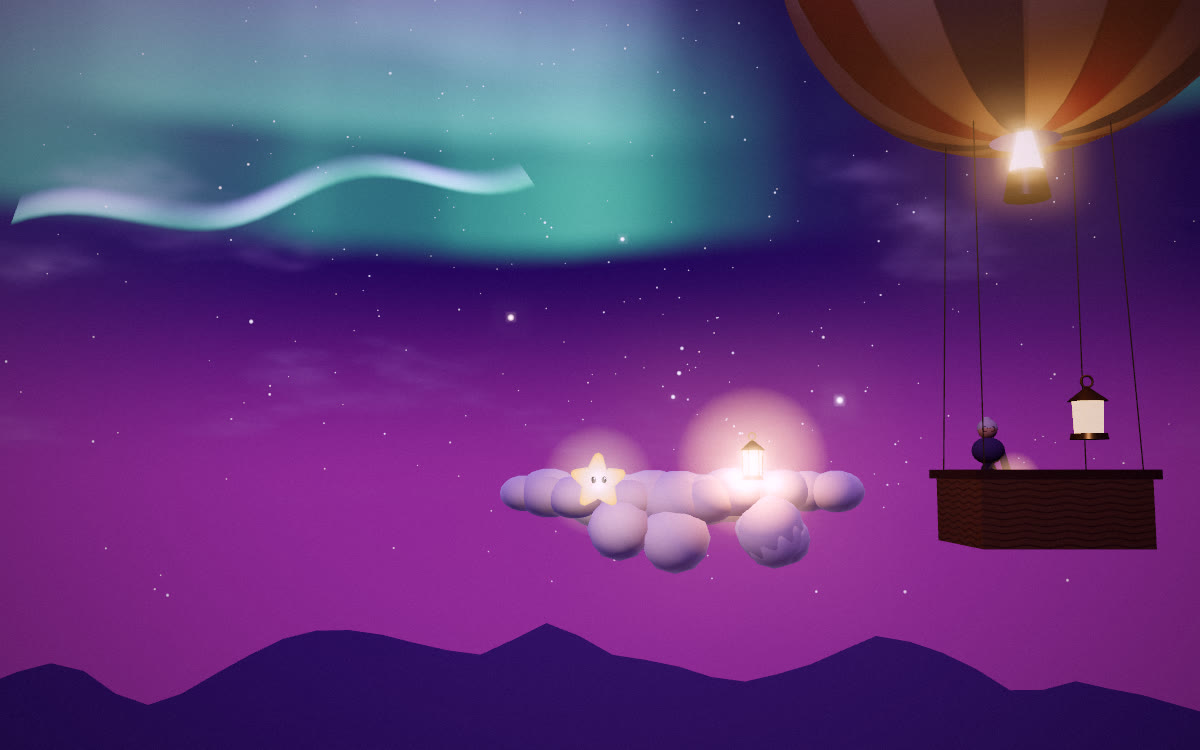
Six nights, one climb each
Every night is one tall level, climbed left and right but always upward, with the world falling away below. You glow: your light lights the walls as you pass, shows hidden steps of starlight, wakes things and draws moths. You fade at dawn, so each night is a climb against the brightening sky, ending somewhere to hide until dark.
The Rooftops
Sills, awnings, washing lines that spring you upward, chimney smoke that lifts you, moths that carry you, a windy crossing, and a jam jar on the highest windowsill.
The Spire
The church tower: ride the clock's hands, wake the gears of the belfry, mind the bats, and ring the great bell to remember the dash. Then up the spire to the little bell at the top.
The Pines and the Falls
Branch to branch through the forest to an owl who teaches you to glide, over a ravine on the air, up a windy mountain path, and beside a waterfall you may only cross where it breaks on the rocks.
The Observatory
Icy rocks to the summit, where Ilse, an old astronomer, has charted a gap in the sky all her life. She shows you how to pulse, and her dome opens to star-lamps you wake with it.
Above the Clouds
Ilse's balloon rises a cloud bank at a time when you give its burner your light. Around it: soft clouds that sink underfoot, geese flying south, and the aurora, whose ribbons carry you.
The Last Ascent
Past the end of the air: star-steps, star motes that give back your dash and pulse in mid-air, comet streams and turning rings of light, up to the gap you fell from.
How to play
- ←→ or AD move
- Space ↑ or Z jump; hold to jump higher
- Hold jump while falling to glide (from the third night)
- ↓ + jump drops through a ledge
- Shift or X dash, aimed with the arrows (from the second night)
- E or C pulse: a burst of light that lifts you once in the air and wakes things (from the fourth night)
- Esc or P pause; M sound on or off
- Gamepad: stick to move, A jump, X dash, Y pulse
On a touch screen, put your left thumb anywhere on the left half of the screen to move, and use the Jump, Dash and Pulse buttons on the right. Lamps are checkpoints: if you fall a long way or go out, you wake at the last one you lit. Seven wishes hide in every night, 42 in all: wishes people made on you as you fell, each with a line of its story. You don't need them to finish.
The real seven sisters
The Pleiades (also called Messier 45) are a cluster of stars in the constellation Taurus, the bull, about 440 light-years away. The cluster holds hundreds of stars, but only a handful are bright enough to see without a telescope. Most people see about six. Sharp eyes under a dark sky can see more.
In Greek myth the Pleiades are the seven daughters of the Titan Atlas and the sea nymph Pleione: Alcyone, Asterope (or Sterope), Celaeno, Electra, Maia, Merope and Taygete. Their names are given to the cluster's brightest stars, and so are their parents'. Of the seven stars named for the sisters, Celaeno and Sterope are the faint ones.
The missing star is an old puzzle. The Roman poet Ovid, writing about two thousand years ago in his Fasti, says the Pleiades are called seven but are usually six, and gives two tellings of why: Merope hides because she alone married a mortal, or Electra hides her face in grief for the fall of Troy.
Many other peoples tell of the cluster as a group of sisters or young women. In Aboriginal Australian traditions the Seven Sisters flee across the land and into the sky from a man who pursues them. In a Kiowa story, seven girls are lifted into the sky on a rock that grows beneath them, at the place now called Devils Tower in Wyoming, and become the Pleiades. In Japan the cluster is called Subaru.
What the game invents: the fallen star, the village, the wishes, the owl and Ilse the astronomer are all made up for this story. In the game, the seventh sister comes home to Sterope, the faintest of the seven stars named for the sisters. The sky you see around her at the end is real.
Questions
Is it really free?
Yes. There is nothing to buy, no account and no ads.
Do I need to download anything?
No. It plays in your web browser on a computer, tablet or phone. It needs WebGL, which current Chrome, Edge, Firefox and Safari all have.
How long is it?
Six nights, each one climb. A first climb takes somewhere around half an hour to forty-five minutes, more if you look for all 42 wishes.
Does it save my progress?
Yes. The game saves at every lamp you light and at the end of each night, in your browser on that device. Nothing is sent to us. Come back with the same browser and choose Continue.
What happens if dawn comes before I hide?
The star sleeps through the day beside the last lamp she lit, and the next night begins from there with the whole dark ahead. You lose only the climb since that lamp. The end screen counts how many nights the climb took.
Can I play on a phone or tablet?
Yes. On a touch screen your left thumb moves her anywhere on the left half of the screen, and Jump, Dash and Pulse buttons sit on the right. A keyboard or a gamepad also works.
Are the stars at the end real?
Yes. The ending draws the sky around Taurus from a real star catalogue: the positions, brightness and colours of the stars come from the Hipparcos satellite's measurements, as published in the open-source d3-celestial project. The Pleiades, Aldebaran and the Hyades are where they are in the sky.
Is the story of a lost seventh sister real?
The idea is very old. The Pleiades are called the Seven Sisters, but most people see six stars, and the Roman poet Ovid wrote about two thousand years ago that the sisters are called seven but are usually six. The game's own story, the fallen star, the village and Ilse the astronomer, is invented.
Made with
Everything you see is drawn in code with three.js, and every sound and note of music is synthesized in your browser. The star data (stars to magnitude 6 near Taurus, the constellation figures and names) comes from d3-celestial by Olaf Frohn, under the BSD 3-Clause licence:
The d3-celestial licence
Copyright (c) 2015, Olaf Frohn
All rights reserved.

Redistribution and use in source and binary forms, with or without modification, are permitted provided that the following conditions are met:

1. Redistributions of source code must retain the above copyright notice, this list of conditions and the following disclaimer.

2. Redistributions in binary form must reproduce the above copyright notice, this list of conditions and the following disclaimer in the documentation and/or other materials provided with the distribution.

3. Neither the name of the copyright holder nor the names of its contributors may be used to endorse or promote products derived from this software without specific prior written permission.

THIS SOFTWARE IS PROVIDED BY THE COPYRIGHT HOLDERS AND CONTRIBUTORS "AS IS" AND ANY EXPRESS OR IMPLIED WARRANTIES, INCLUDING, BUT NOT LIMITED TO, THE IMPLIED WARRANTIES OF MERCHANTABILITY AND FITNESS FOR A PARTICULAR PURPOSE ARE DISCLAIMED. IN NO EVENT SHALL THE COPYRIGHT HOLDER OR CONTRIBUTORS BE LIABLE FOR ANY DIRECT, INDIRECT, INCIDENTAL, SPECIAL, EXEMPLARY, OR CONSEQUENTIAL DAMAGES (INCLUDING, BUT NOT LIMITED TO, PROCUREMENT OF SUBSTITUTE GOODS OR SERVICES; LOSS OF USE, DATA, OR PROFITS; OR BUSINESS INTERRUPTION) HOWEVER CAUSED AND ON ANY THEORY OF LIABILITY, WHETHER IN CONTRACT, STRICT LIABILITY, OR TORT (INCLUDING NEGLIGENCE OR OTHERWISE) ARISING IN ANY WAY OUT OF THE USE OF THIS SOFTWARE, EVEN IF ADVISED OF THE POSSIBILITY OF SUCH DAMAGE.